



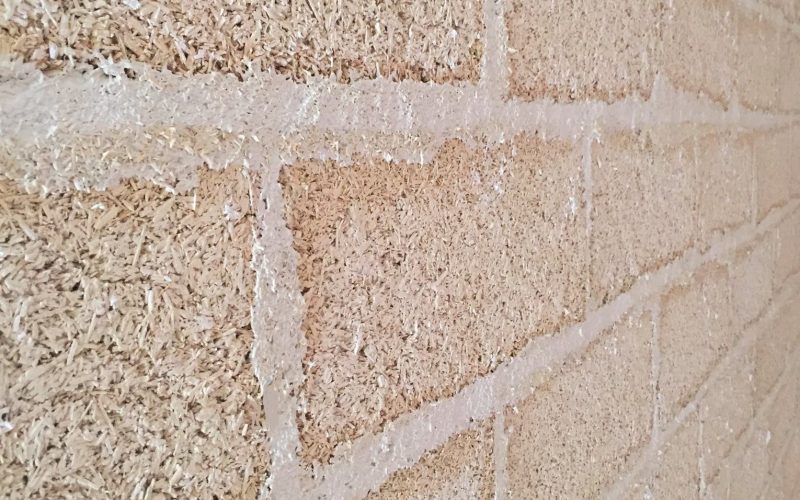
The thermal transmittance of the Biomattone measures how much heat passes through the wall, and it decreases with thickness: from U 0.5 W/m²K for the BA8 to U 0.09 W/m²K for the BA50. Thermal resistance (Rt), by contrast, increases from 1.99 to 11.53 m²K/W.
At a glance
- Thermal transmittance (U): how much heat passes through; the lower it is, the better the insulation.
- Thermal resistance (Rt): how strongly the wall resists the flow of heat.
- Values: U from 0.5 to 0.09 W/m²K; Rt from 1.99 to 11.53 m²K/W.
- Material: thermal conductivity 0.044 W/mK.
- Source: Biomattone® technical data sheet NOV25.
Updated October 5, 2026. Data source: Biomattone® NOV25 technical data sheet.
In this article
- What thermal transmittance and thermal resistance are
- Biomattone thermal transmittance by format
- How to read the data sheet values
- Thermal transmittance and design
- Biomattone thermal transmittance in Brescia and Bolzano
- FAQ about thermal transmittance
What thermal transmittance and thermal resistance are
U indicates how much heat flow passes through each square meter of wall and is measured in W/m²K. A low value means better insulation.
Rt measures how strongly the wall resists the flow of heat and is measured in m²K/W. The two values are linked: U is roughly the inverse of Rt.
Biomattone thermal transmittance by format
In the technical data sheet you will find U and Rt for each format. For example, the BA30 has U 0.14 W/m²K and Rt 6.99 m²K/W.
| Format | Thickness (cm) | U (W/m²K) | Rt (m²K/W) |
|---|---|---|---|
| BA8 | 8 | 0.5 | 1.99 |
| BA12 | 12 | 0.34 | 2.9 |
| BA20 | 20 | 0.21 | 4.71 |
| BA25 | 25 | 0.17 | 5.85 |
| BA30 | 30 | 0.14 | 6.99 |
| BA36 | 36 | 0.12 | 8.35 |
| BA40 | 40 | 0.11 | 9.01 |
| BA50 | 50 | 0.09 | 11.53 |
Thermal transmittance improves with each step up in format: the U-value of the BA50 is more than five times lower than that of the BA8.
How to read the data sheet values
To read the data sheet, start with the U-value of the format, then check the Rt, and finally verify which wall build-up the values refer to.
- the block format and thickness;
- any plaster and finishes;
- the source and date of the figure.
Thermal transmittance alone is not enough, though: the Biomattone thermal phase shift, which measures how long heat is delayed, also matters.
Thermal transmittance and design
Legal limits depend on the climate zone and the type of work, so they are checked by the designer. The right format also depends on the complete wall build-up.
Biomattone thermal transmittance in Brescia and Bolzano
For Bolzano, see the performance in cold climates page, with U 0.09 W/m²K for the BA50. For Brescia, there is the formats, prices and technical data page.
The product basics are covered in the guide on what the Biomattone is.
FAQ about thermal transmittance
It is the amount of heat that passes through one square meter of wall, in W/m²K. A low value indicates better insulation.
It depends on the format: from 0.5 W/m²K for the BA8 to 0.09 W/m²K for the BA50. It decreases as thickness increases.
Rt measures how strongly the wall resists heat, and U is roughly its inverse. The higher the Rt, the lower the U.
The BA50, with U 0.09 W/m²K and Rt 11.53 m²K/W. It is also the thickest format, at 50 cm.
No. Thermal phase shift also matters, along with space, wall build-up and climate zone. The complete project needs to be assessed.